2024–2025 Master of Bioenvironmental Monitoring and Assessment (M.BEMA): May–July Field Journal
Names have been changed to respect privacy.
May 2025
May 5 was my first day of work at the St Clair National Wildlife Area (SCNWA). I met two of my primary teammates: Isaac Pereira, a summer student from the University of Toronto, and Camryn McFadden, my direct supervisor. Following our introductions, Camryn went outside to scope out the wetland; he returned moments later. “Have you two heard of mute swans?” he asked. Isaac and I shook our heads. “They’re invasive,” he continued, hustling over to a gun safe at the other end of the office. I headed to the door for a look outside. “No,” said Camryn as I stopped midstep. “You’ll scare them off.” Retrieving a shotgun from the gun safe, he began loading the firearm with shotshells, glancing through a window between rounds. The window provided a view of the wetland: water, reeds, and lily pads directly outside the office’s northward wall.
I’m being overly fancy with my words. This is a journal entry, not a novel. In summary, Camryn strutted outside, shouldered his shotgun, and blasted two mute swans from the edge of the marsh. The first one crumpled in the water, its neck collapsing forward in an awkward arch; the second bird beat its large wings against the surface, attempting to take flight. BANG. Not a chance—its bulky body floundered in the shallows, eventually drifting motionless beside its lifeless mate. All right, enough description. It was an eye-opening first impression of both Camryn and the SCNWA: conservation involves a lot of death. Along the wetland dykes, you can often find a decomposing muskrat or flattened bullfrog. Not every day, but often enough. Remnants of predation can likewise be observed: scattered feathers, tufts of fur, bones of birds and rodents.
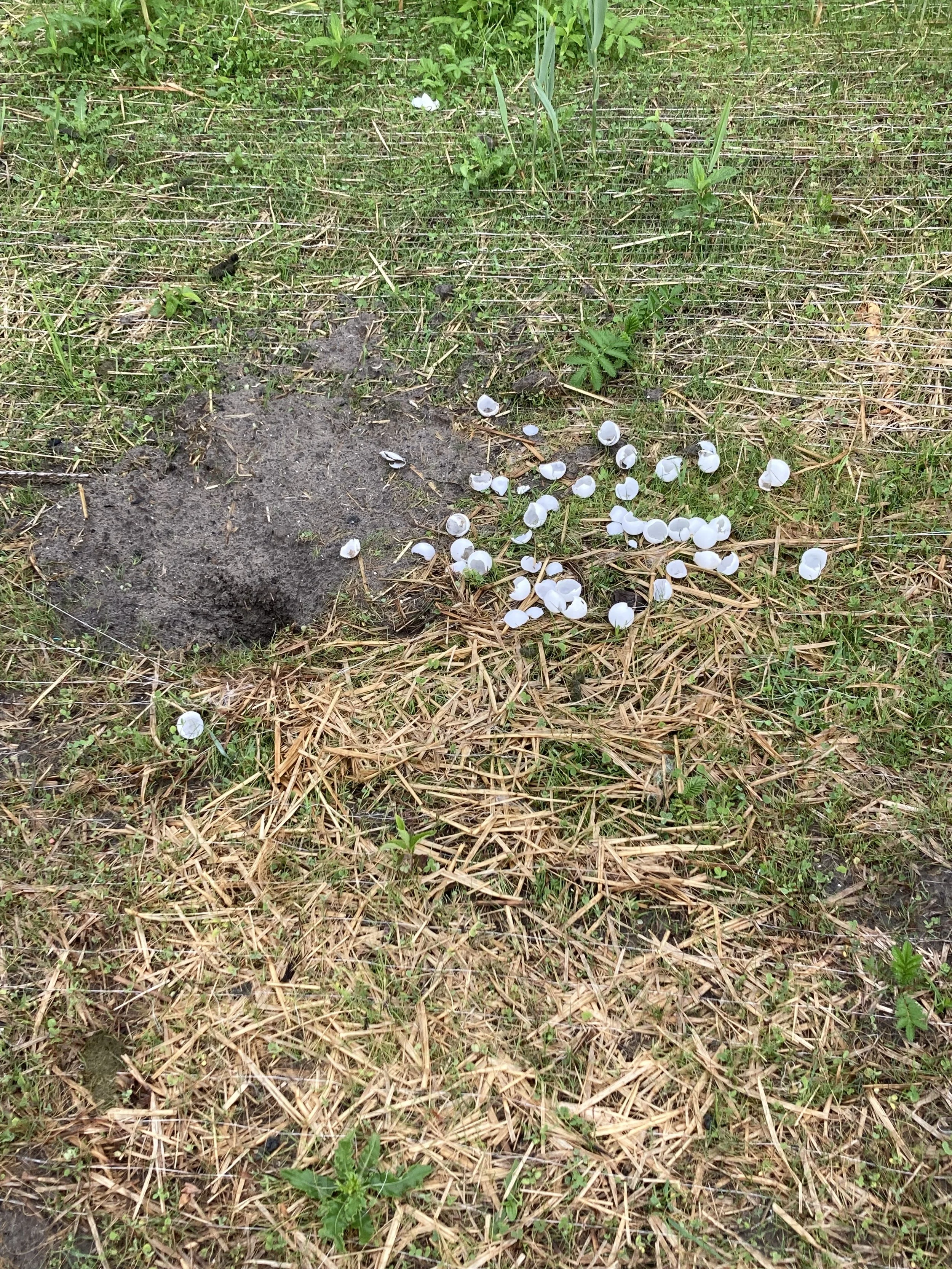
Excavated turtle nests epitomise the frequency of devastated prey items: across the dykes, broken eggs lie strewn about the torn-up nesting sites, pillaged and devoured by raccoons. It’s brutal, man: an absolute massacre. If you anthropomorphise the turtles, or sympathise too closely with them, it all seems so tragic. Female snapping turtles, for instance, reportedly reach sexual maturity between the ages of 15 and 20. Within a few weeks of mating, they emerge from the muddy depths, lumbering onto the land. A single clutch can take hours to deposit: the female uses her hind legs to scoop away the earth, sometimes pissing on the ground to soften it. She guides her cargo into the cavity: around 20–40 eggs on average, each positioned carefully with her feet. After finishing the task, the turtle buries the nest; she claws a mound of dirt overtop, concealing the clutch before leaving the eggs to incubate on their own.
All things considered, it’s a terribly long process: sexual development to ovipositioning. The turtle spends so much bloody time on the nest, she negates her discretion, leaving a good amount of scent in the vicinity. Raccoons are quick to detect the evidence; they’ll eradicate the clutch in a matter of minutes, digging up the eggs in either daylight or darkness. Entropy at its finest—disorder happens so easily. Such relationships between life and death have been glaringly palpable over this first month of work; they’ve reinforced my commitment to conservation. Of course the raccoons have to eat; they’re an important part of the wetland’s community. That said, the little washer rats* have no shortage of food in the region: plenty of seeds and insects to devour.
I’ve put together some two-by-fours and sheets of wire mesh, constructing about a half-dozen nest protectors. Overall, they’ll hardly thwart the raccoons; however, I’ve felt a great sense of gratification in mitigating the raids. In roughly 9–14 weeks, hundreds of hatchlings will breach the embankments; they’ll abandon their nests, scraping through the muck to begin their lives in the open marsh.
*ratons laveurs is the French term for raccoons, translating to washer rats.
June 2025
On June 2, SCNWA was visited by an Islamic high school: a few dozen students and teachers in attendance. I co-led the group, pointing out different plants and animals—answering questions about poplars and frogs. It was an interesting experience: a good opportunity for both scientific and cultural exchanges.
On June 6, I received birdhouse advice from Brian Lundqvist: a colleague at the Big Creek National Wildlife Area; he recommended adding perches to my purple martin design. It was a brief interaction, but it felt good to cooperate with a fellow summer student.
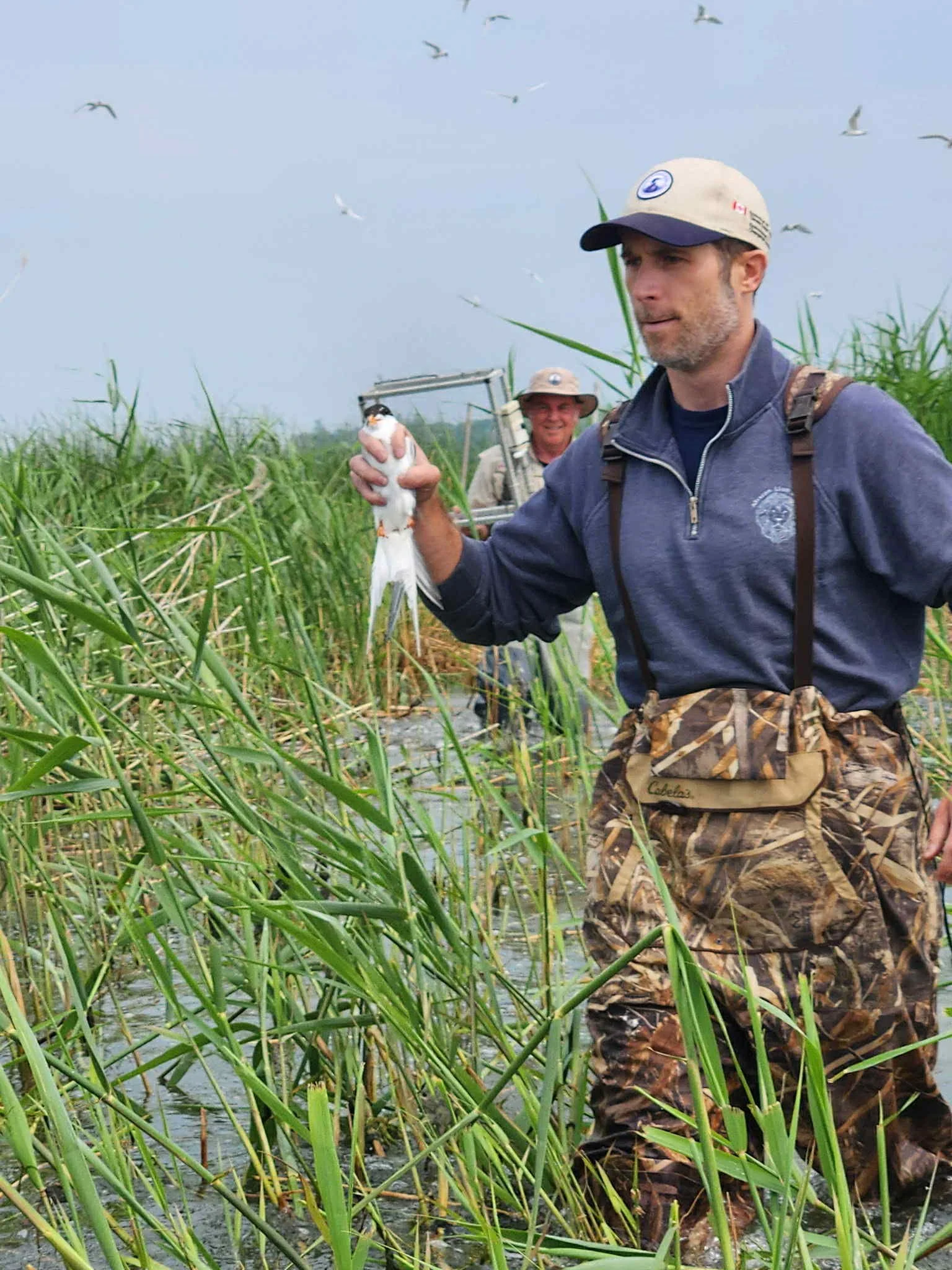
For about the first two weeks of June, two Canadian Wildlife Service (CWS) employees from Toronto stayed with Isaac and me at SCNWA. On the 12th, we joined them for a waterbird survey, focusing on Forster's terns. Geoffrey Cruise was the lead biologist; his assistant was Priya Patel, an undergraduate student from U of T. We set out in a pair of boats at Mitchell's Bay; it was an epic experience, one of the best moments of my life. Along with our secondary supervisor, Owen Schrader, Isaac and I took turns accompanying Geoffrey to a triggered trap, which had been set over a nest on a reed-covered island. I held a captured tern in a songbird grip, trudging through the mire as I waded back to the team. The moment felt so bloody heroic; I’d secured the target successfully. My waders were leaking, though. Maybe it's just the cold, I thought at first—nope. My pants were definitely getting soaked from the crotch down. Back at the boat, I held the bird up to Priya, who took measurements and blood, a quick scan of the feathers for parasites. With Priya's approval, I released the tern. It flew off, unharmed, returning to its colony.
Towards the end of June, Camryn invited Isaac and me to accompany him for goose banding. That was a great experience, too. We worked with Jacob Vance: a wildlife biologist on Geoffrey's team. In general, that's been one of my favourite parts of this job—collaborating with other researchers. We tracked down some geese at a park: both adults and goslings. As a group, we corralled the geese towards a latticed barrier, wrapping it around the birds and closing them inside as they neared. One by one, Jacob lifted the geese, handing them off to assistants. "Here," he said to me. "Adult female with a brood patch." I cradled the goose in the nook of my arm, keeping its feet from flailing. The bander approached, and I repeated the details: adult female with a brood patch. A ring was secured to the goose's leg, pulled from a stick of numbered bands; subsequently, I let the bird go. By the end of the process, I was covered in scratches and shit; the day was an absolute blast.
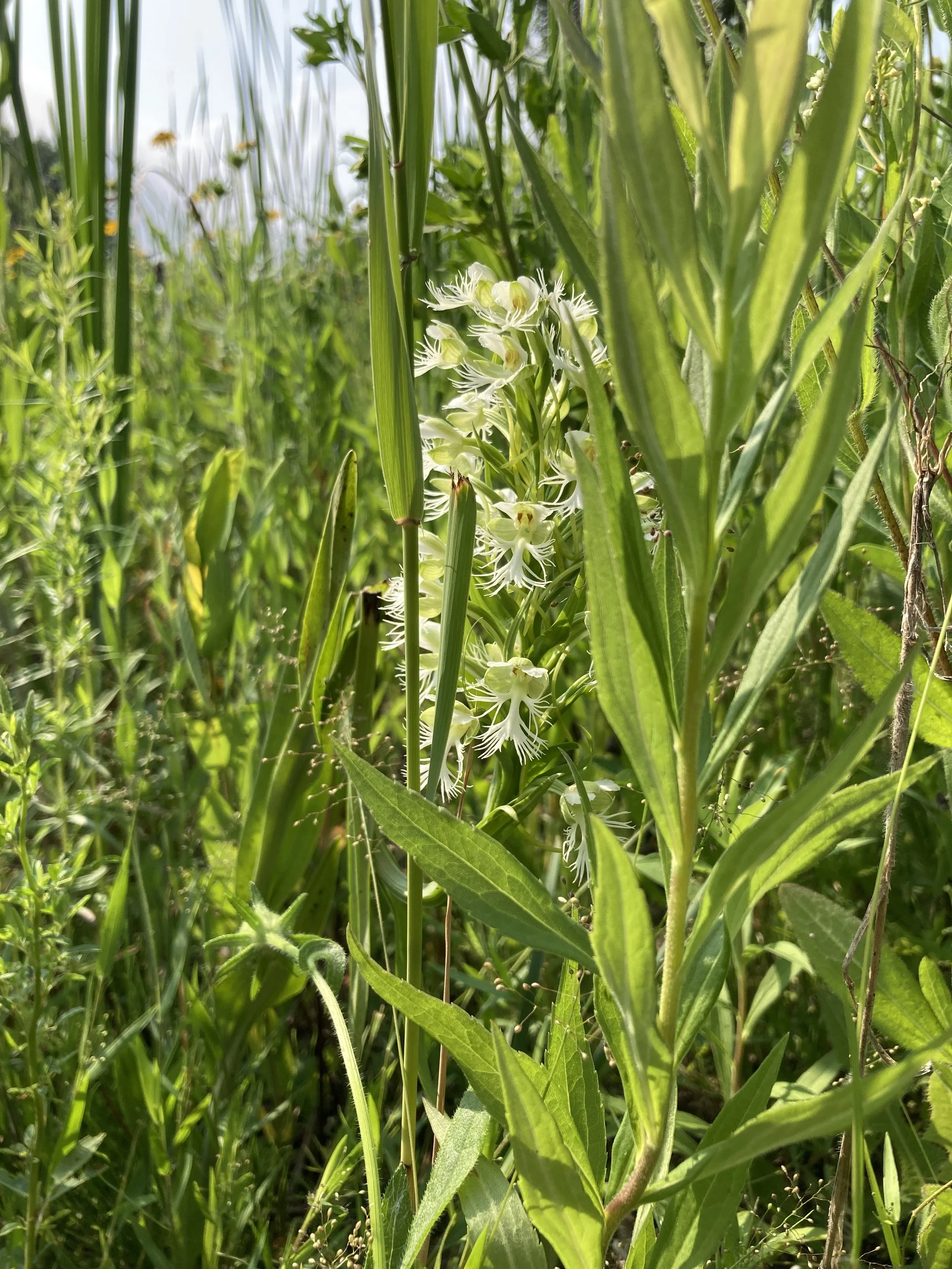
On June 26, Owen discovered that the eastern prairie fringed orchid had bloomed at our region's Bear Creek unit. This demanded immediate attention, as the flowers are evanescent. Owen wanted to flag each plant's location for manual pollination at a later date. Time was of the essence. The following day, Camryn, Owen, and I spent six hours in the heat, sweltering throughout the effort. We flagged nearly 200 individual plants. Although the work was tiring, it felt like a worthwhile challenge. This exemplifies another thoroughly enjoyable part of my contract: there's a good mix of ecological tasks—altogether, I've appreciated the opportunity to work with both wildlife and plants; each experience has buttressed my professional versatility.
July 2025
On July 3, we had a team barbecue: Camryn, Owen, Isaac, and I. It was good to socialise with my coworkers, interact outside a professional context. Another highlight from the previous month occurred between June 15 and 16: Isaac and I joined the Habitat Assessment and Data Management Unit at Bear Creek and Mitchell’s Bay for sampling benthic invertebrates.
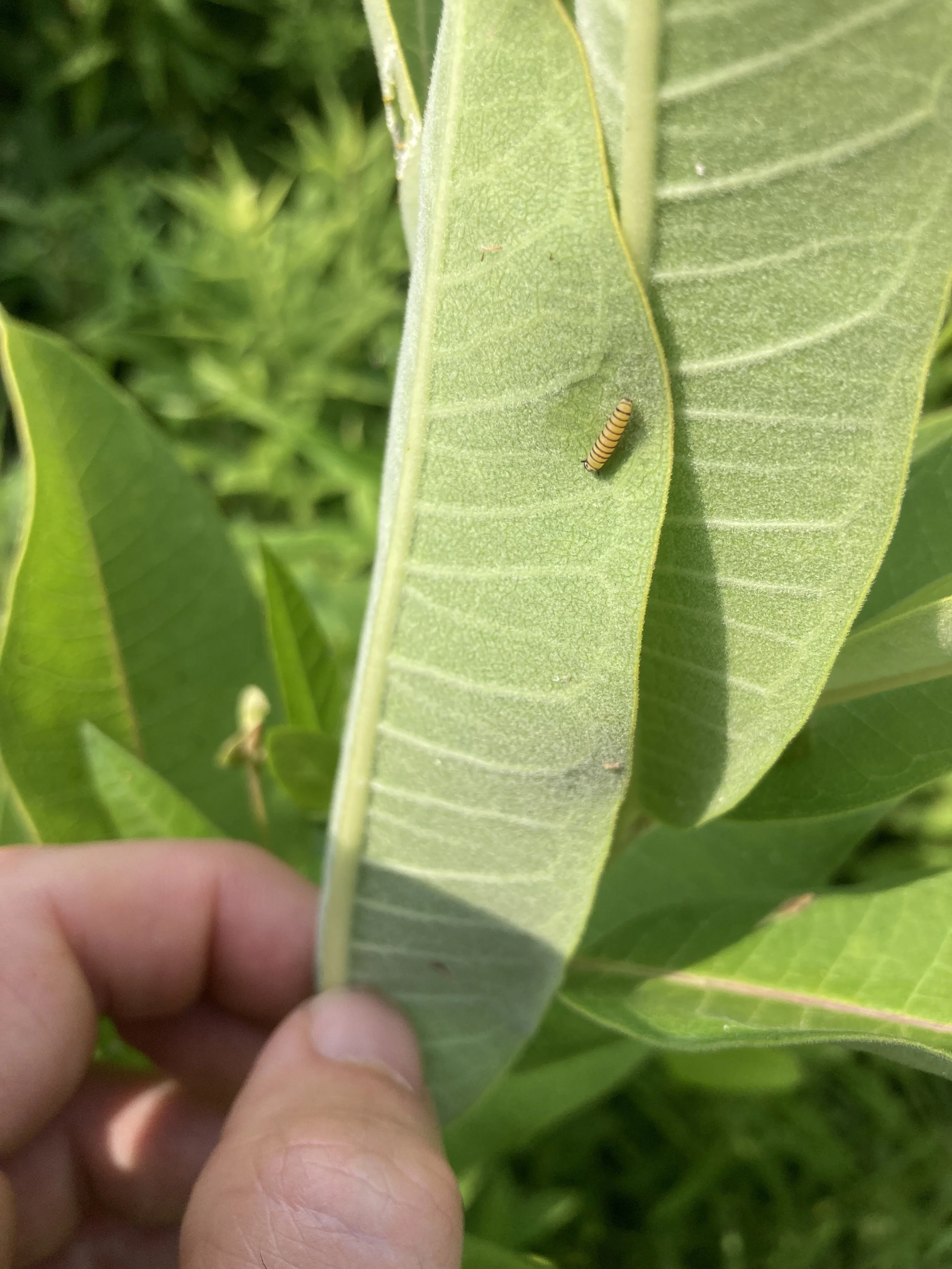
Mission Monarch surveys were in full swing: a biweekly effort since the end of June. Isaac and I monitored adult butterflies at both the St Clair and Bear Creek units; similarly, we scoured milkweed stems for eggs and instars. It's a relatively easy task; however, it can feel like a slog—especially at Bear Creek. The vegetation's wild. Plodding through the tangle of plants can be exhausting; bug spray hardly works against the onslaught of mosquitoes. That said, it's another fun challenge at the end of the day; since beginning my pursuit of a career in biology back in 2020, I've been dreaming of participating in rigorous fieldwork.
On July 10, Isaac and I flagged potential turtle nests along St Luke's dyke: an embankment to the east of St Clair, property of Ducks Unlimited Canada. This was done ahead of Phragmites mitigation—in the coming weeks, excavators will plow through the area to dredge the wetland and remove large sections of the invasive plant. That's a good segue into relevant events: On July 15, Isaac and I were instructed to map the coordinates of both Phragmites and purple loosestrife (Lythrum salicaria) locations. We took the boat out for a survey: I operated the mud motor, while Isaac recorded data from the bow. After completing the first section, we had to pull the boat from the water, drag it over the dyke, and slide it into the opposite side; while doing so, I inadvertently pressed my bicep against the motor's muffler. Bloody hell, that hurt; it left a second-degree burn. It was juicy for days, man. When it happened, I was able to push past the pain; Isaac and I continued our work without issue.
Six days later, I mentioned the incident to Camryn in passing, just shooting the breeze over lunch. He brought it up the next day: "I've thought about the burn," he said. "We've gotta report it." Ah fuck, I thought—I don't want anyone to fuss over this. I expressed my aversion to an injury report, but I didn't complain excessively. Camryn's the boss; it's his call. More importantly, it's protocol. Camryn noted my summary of the incident, drafting a report. After he signed it, it was sent to Camryn's supervisor; after she signed it, it was sent to Camryn's supervisor's supervisor. My signature was the final step on our end of the process; subsequently, the document was sent to another department, which reviewed the report and recommended extra precautions against boating hazards.
I won't go much further into a tangent, but all of this really pissed me off in the moment. Despite the collage of signatures, our first report was rejected. It hadn’t satisfied the department’s Safety Committee: “Has David read the Safe Operating Procedure for mud motors?” they asked bureaucratically. “Was he overworked, tired, or suffering from heat exhaustion?” For goodness’ sake, accidents happen in the field. The response felt out of touch, condescending—something of the sort. I was ruminating about broader issues. On its own, the injury report wasn't a big deal at all. Feeling infantilized is just one of my biggest pet peeves. Anyway, I do recognise that my frustrations stem from ego in a prominent way: getting all that attention from Camryn and his supervisors, I felt embarrassed. My humility perceives things more responsibly: reporting the incident was the right thing to do. Were the injury to get infected, the document would justify compensation. Additionally, the report may lead to a better emphasis on safety measures around the motor for future employees, perhaps saving the next student from a very bad burn. As I publish this nearly a year later, there’s a white, nickle-sized scar on my arm.