Biblical Symbolism: The Importance of a Cautious Approach to Scripture
My mom was an Anglican priest, so I grew up with a lot of biblical stories. Preaching can be a good thing; it can also be excessive. It can feel pushy, sanctimonious, demoralizing—it can spur rebellion. I’m wary of that when I talk about this stuff. So, I don’t mean at all to proselytize. I’d just like to share a bit of my experience.
The concept of sin can make you feel bad about yourself; you’re especially susceptible to this as a kid. There are lots of different perspectives in the Church. Accordingly, things aren’t always taught in an optimal way. Some Christians are pious and obliviously judgmental. Spend enough time with them, you’ll be made to feel ashamed for things that don’t necessarily warrant guilt. Similarly, expressions of grief can feel invalidated by overly simplistic platitudes. If you’re looking for answers to heartache, poverty, illness, etc., statements like “turn to God” or “all you need is Jesus” can seem dismissive—they’re often not very helpful in times of pain, particularly when you’re new to the idea of faith.
There’s a tendency in the Church to over-spiritualize things. In some communities, this has led to an aversion to secular means of healing: medicine, music, psychotherapy, and so on (Hann, 2003; Lloyd et al., 2021; Riley, 2026). I thoroughly disagree with this position. For me, God and science are far from incompatible. Those are broad categories. You can fit spirituality/theology/philosophy under God, biology/psychology/etc. under science. A Venn diagram would be good; there’s some overlap—art could arguably apply to both circles. My point is that, from a Christian perspective, we rely on God for everything. That said, I believe that we’re expected to take action. We have tools at our disposal to both help ourselves and the world around us. In that regard, it would be irresponsible to sit back and wait for God to solve all our problems, including the problems that unfairly befall us.
Nature, conscience, physical health: we’ve been given these things to both learn about God and do good works in this life, to mend what’s broken—to establish a better state of being for future generations. This can seem discouraging at times, like a mission without adequate direction. That said, we’re not alone. We have friends, mentors, family members. Sometimes, God can intervene in miraculous ways to both help and comfort us, but those moments are often few and far between. There’s support and opportunity all around us. I believe, for example, that our loved ones represent a tangible means of giving God a hug.
All of my aforementioned complaints about the Church drove me away from religion for a very long time. It wasn’t till maybe six years ago that I began seeing the Bible as a book of wisdom. There’s a lot of meaning in the stories—lessons for life, instructions on how to overcome adversity. For people suspicious of Christianity, it can help to approach Scripture through a secular lens. Literary and psychological assessments can be applied to the stories; these can lead to valuable insights, applicable to your own life’s challenges and aspirations. The notion of giving into temptation, for example, shouldn’t be considered strictly in the context of eternal consequences. You don’t have to believe in Hell or damnation to know that poor choices can precipitate misery.
Basically, the doctrine of sin shouldn’t be taught in a way that provokes shame. The Bible’s lessons are there to protect us, not to suppress us with arbitrary rules. It’s a controversial book. The stories can be misinterpreted; they can be used for harmful motives. Whether it’s a divinely inspired text or not, the Bible comprises an inescapable problem. It relies on words—and words are imperfect. They’re imperfect because they’re inherently symbolic; they signify an intended meaning as opposed to embodying the meaning itself (Nietzsche, 1962). We can do our best to navigate them correctly; however, we’ll often fall short of an accurate exegesis.
All of this brings me to my primary point: the Bible should be approached very carefully. Its frequent instances of metaphor can lead to an overly superstitious mindset. This isn’t to say that the Bible’s purely figurative. I think that it’s a blend of symbolism and unequivocal truth. Without appropriate guidance or discernment, a person might fail to grasp the overall message. The idea of biblical metaphor is contentious. Fundamentalists, for example, subscribe to a mostly literal interpretation of Scripture. Such convictions correspond with Young Earth Creationism, which maintains that God created the world in six, 24-hour days—as suggested in the book of Genesis. This represents a prominent schism in the Church. Although non-literal interpretations may be perceived as speculative by comparison, they can refer to complementary passages to justify their inferences. 2 Peter 3:8, for instance, states that “one day is with the Lord as a thousand years, and a thousand years as one day.” Such verses undermine a predominantly literal impression of the Old and New Testaments, including the assumption of a six-day creation story.
Ultimately, the presence of figurative language indicates a biblical necessity. It permits an escape from finite analyses, facilitating greater comprehension of an otherwise ineffable God. Perhaps the strongest argument for the ubiquity of symbolism is the scriptural fact that Jesus taught in parables. Stories like the Good Samaritan (Luke 10:25–37) and Prodigal Son (Luke 15:11–32) exemplify accessible frameworks for multifaceted lessons; they imply a scriptural dependence on comparative devices, each provoking a vicarious experience through tangible examples of right and wrong. With regard to Luke 10:25–37, the image of a man beaten, left for dead, neglected, and finally rescued by a stranger imparts a visceral illustration of “love thy neighbour as thyself.” It demonstrates an ethical standard of universal compassion, extending beyond a selective scope of familiar relationships. From this point of view, Jesus’s parables offered far more clarity than what the relatively abstract laws of the Old Testament could provide. They reinforced a broader practice of analogical teaching, supplementing a creative arsenal of metaphor, simile, and other forms of expression to convey a moral order (e.g., Matthew 10:16; Mark 4:30–32; Luke 11:11-13; John 15:1–8).
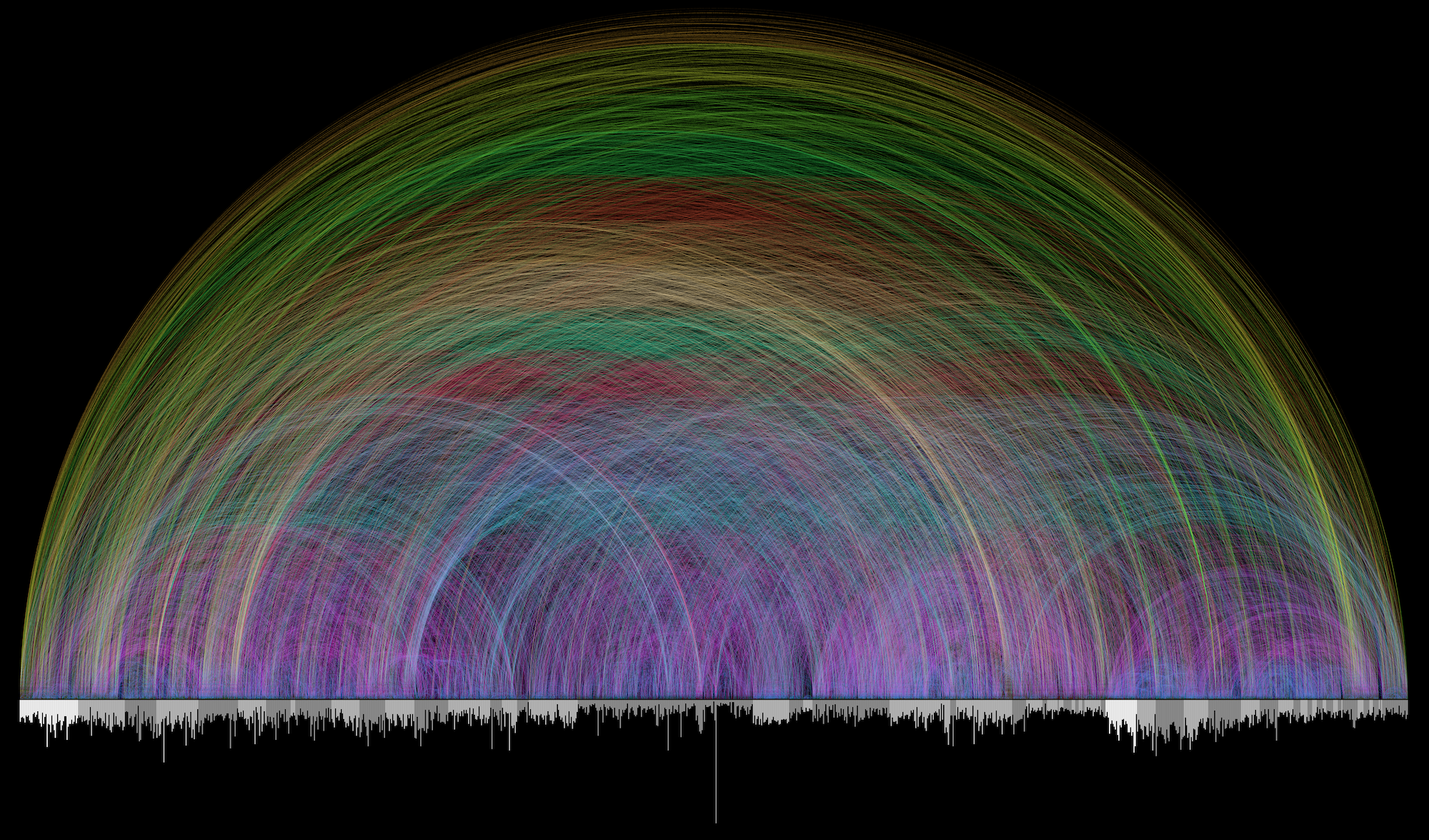
Figure 1. Bible cross-references, by Chris Harrison. Biblical books (66) are represented by shades of grey. Lines represent chapters; longer lengths correspond with greater word counts. Colours show connections between passages (63,779 cross-references), correlating with longer and shorter distances between books, e.g., green denotes relatively long distances between books, while purple signifies shorter distances between books.
In closing, I’d like to reiterate the pitfalls of scriptural ambiguity. The Bible comprises a landscape of symbols. It includes visions, dreams, and other images, each revealing a deeper reality. I won’t go into further examples here to buttress the claim. Both the Old and New Testaments are full of relevant instances (e.g., Genesis 28:12–13; Genesis 41; Daniel 2; Acts 10:9–16). These layers are profoundly complex—it can be difficult to distinguish between literal and figurative language, between explicit and implicit representations. Without an attentive reading, the Bible can be easily misconstrued. I’m not just speaking from experience; plenty of psychological and theological articles describe this hazard (Lindo, 2021; van Dyk, 2018). When it comes to the possibility of misconception, young minds are especially vulnerable. I believe that the Church exacerbates this issue by underestimating a child’s imagination; it overlooks the potential for long-term repercussions. Depictions of the Devil, for example, can lead to existential dread, including protracted fears of a fiery afterlife (Cole, 2023; Firth, 2023; Shariff & Aknin, 2014). In this regard, the Bible’s darkest aspects may be best reserved for a later stage in life. I’m not advocating for a child to be coddled; however, perhaps an optimal introduction to Christianity would prioritize an assurance of love, compassion, forgiveness, and mercy over anything demonic or condemnatory.
References
Biblical quotations were taken from the King James Version.
Chris Harrison’s Bible cross-references image can be found here.
The article’s Feature Image was created by an anonymous artist in 1537, reportedly from the circle of Jon van Scorel; it’s housed in Rijksmuseum, Amsterdam.
Cole, M. (2023). Psychological effects of Christian teachings about sin and Hell. Mental Health, Religion & Culture, 26(8), 736–754. https://doi.org/10.1080/13674676.2023.2261412
Firth, W. (2023). Hell: Educationally in post-secular societies. Verbum et Ecclesia, 44(1), Article a2759. https://doi.org/10.4102/ve.v44i1.2759
Hann, C. M. (2003). Creeds, cultures and the “witchery of music.” The Journal of the Royal Anthropological Institute, 9(2), 223–239. http://www.jstor.org/stable/3134647
Lindo, R., Jr. (2021). Karl Allen Kuhn, reading the Bible badly: How American Christians misunderstand and misuse their scriptures. Review & Expositor, 118(3), 383-384. https://doi.org/10.1177/00346373211059024b
Lloyd, C. E. M., Reid, G., & Kotera, Y. (2021). From whence cometh my help? Psychological distress and help-seeking in the Evangelical Christian Church. Frontiers in Psychology, 12, Article 744432. https://doi.org/10.3389/fpsyg.2021.744432
Nietzsche, F. W. (1962). Philosophy in the tragic age of the Greeks (M. Cowan, Trans.). Regnery Gateway.
Riley, J. (2026). Religion and science, faith and medicine: A worldviews approach to English evangelical medics’ perspectives. Critical Research on Religion, 14(2), 205-221. https://doi.org/10.1177/20503032251381312
Shariff, A. F., & Aknin, L. B. (2014). The emotional toll of Hell: Cross-national and experimental evidence for the negative well-being effects of hell beliefs. PLOS One, 9(1), Article e85251. https://doi.org/10.1371/journal.pone.0085251
van Dyk, P. J. (2018). When misinterpreting the Bible becomes a habit. HTS Teologiese Studies/Theological Studies, 74(4), Article a4898. https://doi.org/10.4102/hts.v74i4.4898